Joao Paulo Schwarz Schuler
There is not such a thing as free energy. But we can harvest energy with diodes. This is a just a hobby and I don't intend to do a big science from it.
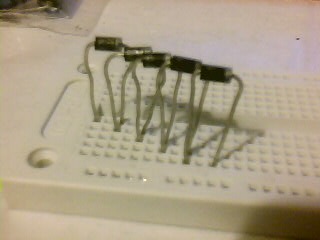
I've got 25 1N4003 diodes 200V 1A for testing because they were very cheap (US$2). Then, I placed 5 of them in a cheap proto board (bread board) and measured voltage in their extremities with a cheap multimeter DT-830B (US$6). See my open circuit below.
Interestingly, I've got 0.2mV. From where is this small voltage coming from? I don't know. But I've noticed that when diodes aren't exposed to light, the voltage disappears. Placing 10 diodes and 15 diodes in series, I've got 0.4mV and 0.6mV. So, it seems voltage is being added with more diodes. I also had the perception that the amount of light in the environment affects voltage. Current hasn't been perceived probably because the measurement device isn't precise enough.
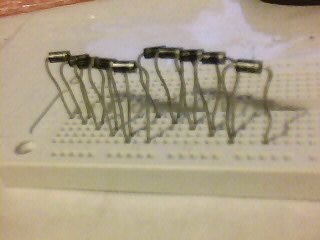
The same experiment was made with FR207, 2A, 1000V fast recovery diodes without any success. Again, no success was recorded with BAT46 Schottky diodes.
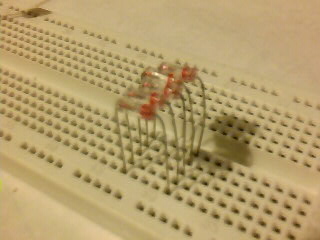
LEDs specs are: 3mm, 20mA, 15mcd, wavelength 590nm, VF Typ. 2.1V, View Angle 60°, VR Max. 5V.
Exposing 1 LED to house light, I was able to measure 0.05mV. Placing 19 LEDs in parallel, I was able to measure 1.10mV. So, voltage seems to be summed when LEDs are placed in parallel. I couldn't measure any current.
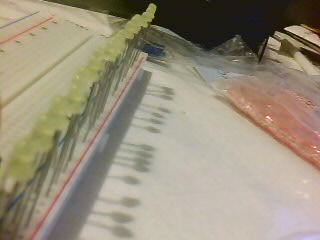
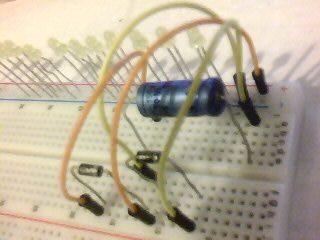
I've got a 150uF 25V Philips electrolytic capacitor. Then I used the 19 LEDs array to charge it through 1N4003 diodes. Voltage slowly climbed up to 1V (1000mV)! I haven't been able to reproduce the experiment. The initial result can have been interfered by an unknown external factor. When using small amounts of current, diode's voltage drop seems very small.
3 types of LEDs were tested in the same conditions for voltage generation under light.
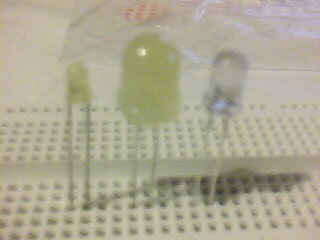
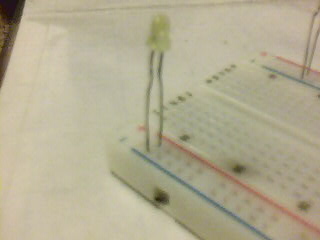
The little small yellow led is the best performing so far as solar cell.
Caracteristics are: 5mm, 3.0V-3.6V, 10000-15000mcd.
Under same conditions of experiment 2:
It seems red LEDs are the best at capturing energy from light.
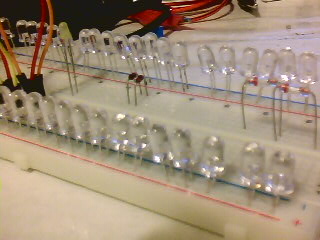
I used a very simple circuit composed by 2 diodes and an antenna as follows:
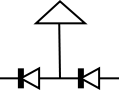
2 germanium diodes 1N270 plus a 2m long insulated wire (antenna) were used. Depending on how the antenna was orientated, voltages up to 1.2 volts were recorded. Similar experiments were made with 1N34 and 1N60 germanium diodes. But the 1N270 seems to be the best. No indication about light interfering in the result has been observed.
Experiment 6 recorded 2000 times more voltage than the experiment 1.
The same experiment has been made with BAT46, 1N4003 and FR207 diodes but results haven't been so good.
Another variation has been made using 2 arrays of 4 1N270 diodes each in parallel (each array replacing each diode in the original experiment). But results haven't been interesting. Using parallel antennas seems to increase voltage requiring further investigation.
After some experimentation around my home, it’s clear that radio waves are being collected from electronic equipments inside my house. There is a light spot that quickly drives up voltage when it’s close to my antenna. Turning off all electronics in my house, I still get from 100mV to 200mV.
I spent half of an hour powering 6 capacitors in parallel up to 0.6 volts each. Then, I placed them in series and powered an LED for few seconds. This is an indication the the amount of current generated from radio waves was small.
A single 1N270 germanium diode generates 26mV and 0.7uA. I suspect that somehow the measurement device is interfering the experiment as antenna. But it's still an interesting result.
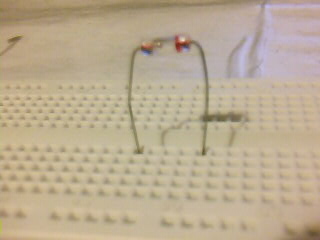
30 germanium diodes in series were tested. Nothing impressive has been found.
A single water clear amber LED, 5mm, peak wave length 592nm, 4000mcd, 1.8V-2.2V, generates 40mV under the same conditions of other LED tests. It might be possible that this LED performs better than others because the lab's light is compatible to this LED.
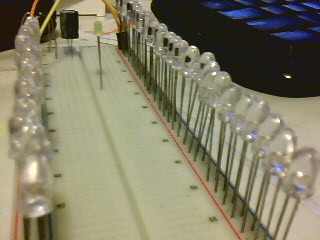
50 LEDs in parallel close to a fluorescent light generated impressive 1.4V.
No significant increase in voltage nor in current was perceived adding 4 diodes in parallel.